Business

Smart Factory

Smart Factory Manufacturing AI for Smarter Factory Work

Use AI to make drawing, inspection, diagnostics, and analysis work faster and more reliable.
Core Services Bring AI into critical manufacturing workflows

Start with the areas that fit your site, security requirements, and operational priorities,
from engineering drawings and inspection to diagnostics, analytics, and reporting.

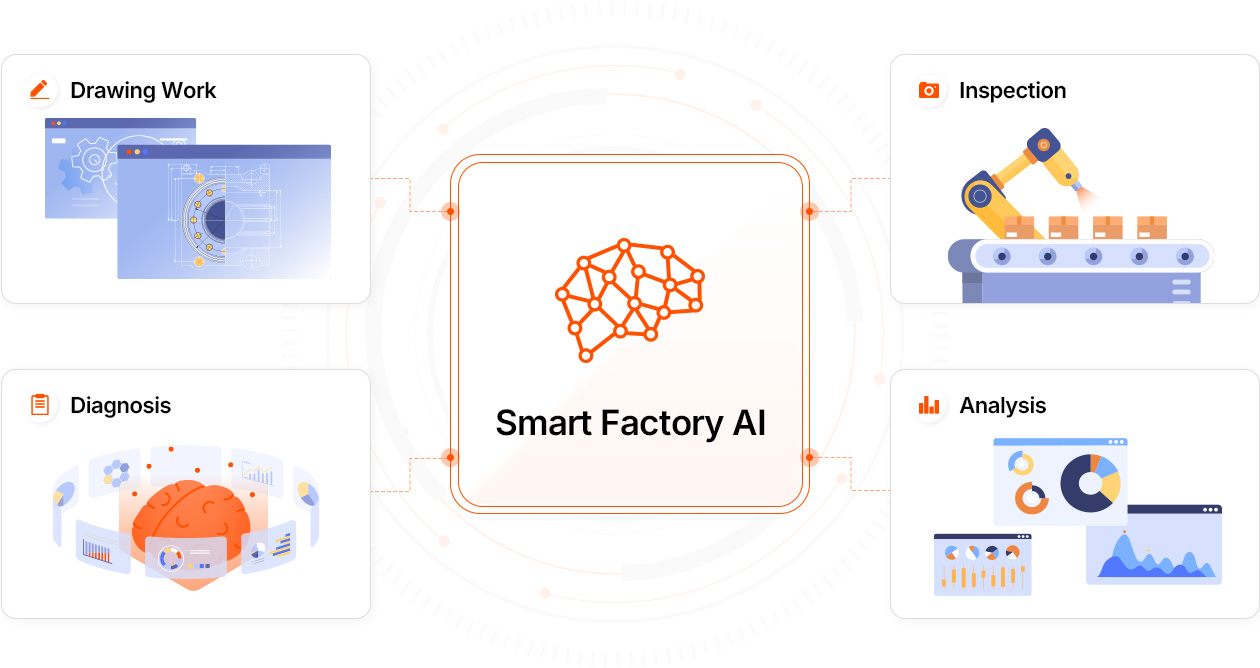
Drawing Intelligence
Turn manufacturing and engineering drawings into searchable, review-ready digital data so engineers can find, validate, and issue the right information faster.
Inspection Intelligence
Add deep learning to existing inspection equipment to detect fine scratches, classify nonstandard defects, and maintain a clearer quality history.
Signal-Based Diagnostics
Analyze equipment and product signals in real time to identify abnormal patterns and prioritize likely causes faster.
Analytics and Reporting
Analyze quality and process data, then turn the results into dashboards, reports, and actionable insights for problem-solving.
Secure AI Deployment
Run AI within internal networks to meet security requirements while working toward target performance.
Operational Challenges Move beyond equipment automation
to smarter process decisions

Productivity improves when teams reduce work that depends on visual checks and individual experience.
Manufacturing AI analyzes process data to support shop-floor decisions.

Experience-Dependent Judgments
Decisions that rely on individual expertise are vulnerable
to changing work conditions and handoffs, making consistent quality harder to reproduce.

Drawing review

Fine and atypical defect judgment

Abnormal-signal interpretation

Fragmented Records
When inspection results and drawing revisions are kept in separate places,
teams lose time tracing past records when similar issues reappear.

Inspection, action, and drawing-revision history

Recurring quality-issue response

Delayed Root-Cause Analysis
When equipment signals and quality data are separated,
missing links between the data slow down analysis of abnormal conditions.

Cross-data review

Lot and batch anomaly patterns

Likely causes and inspection priorities

Manual Analysis and Reporting
When data collection and report creation stay manual,
repetitive work continues to consume shop-floor and engineering resources.

Shop-floor and experiment data analysis

Spreadsheet visualization and report creation

Production Deployment Gaps
PoCs are difficult to put into practice when internal networks,
security requirements, and existing systems are not reflected from the start.

Legacy-system and security review

Testing in real-world environments

Industry Applications Find the right AI fit for your manufacturing environment

Every site faces a different mix of challenges, from defect detection and drawing validation to equipment diagnostics.
Explore AI capabilities matched to your industry's needs.

Semiconductor &
Precision Electronics Manufacturing
Improve defect detection in precision manufacturing processes. Process and inspection data can reveal missed opportunities to improve yield.
AI Inspection
Process Data Analysis
Secure AI Deployment
Mobility &
Industrial Machinery Manufacturing
Faster review of large engineering drawing sets. Abnormal signals from key equipment and finished products can be identified before issues escalate.
Drawing Digitization
Quality History Management
Equipment and Product Diagnostics
Battery &
Chemical Materials Manufacturing
Earlier anomaly detection across continuous production lines. Process data helps narrow likely defect causes when many variables interact.
Real-Time Diagnostics
Process Data Analysis
Likely-Cause Analysis
Pharmaceutical &
Biotech Manufacturing
Secure data handling in isolated on-premises environments, with consistent management of manufacturing records and quality data.
Manufacturing Record Management
Quality Data Analysis
Secure AI Deployment
Energy &
Infrastructure Operations
Faster validation of complex infrastructure drawings. Earlier equipment diagnostics help reduce unplanned downtime risk.
Drawing Validation
Secure AI Deployment
Equipment Condition Diagnostics
Why SURROMIND From field validation to self-sufficient operation,
SURROMIND brings manufacturing AI into practical use
Rapid Validation and Development
With experience developing 300+ AI models, SURROMIND uses Multimodal AI to test complex field data quickly and build the models each site needs.
Integration with Existing Systems
Keep existing equipment and work environments in place. Connect AI only to the processes that need support, from inspection decisions to diagnostics and analysis.
Secure On-Premises Deployment
Build systems for internal networks and on-premises environments, so critical field data can be handled without moving it to external servers.
Problem Solving and Model Improvement
Resolve priority challenges at the deployment site, then give teams an MLOps environment to retrain and improve AI models on their own.
Use Cases See manufacturing AI in practice
  • Engineering Company A

  • Semiconductor Parts Manufacturer A

  • Automotive Group A / Diagnostics

  • Automotive Group A / Analytics

Automated engineering drawing extraction, validation, and release
AI recognizes and validates complex drawing information, turning it into searchable, review-ready data for engineering workflows.
Micron-level semiconductor component inspection
AI detects fine defects and irregular defects, increasing inspection throughput by 310% and reaching 96.3% inspection decision accuracy.
Acoustic engine anomaly detection and root-cause analysis
Acoustic data is analyzed to distinguish normal and abnormal states, identify failure types, and achieve 96% diagnostic accuracy with a 28 percentage-point improvement over the baseline.
Test data analysis, automated visualization, and report generation
Test data is analyzed, visualized, and formatted into reports to reduce repetitive analysis and reporting work.
swipe